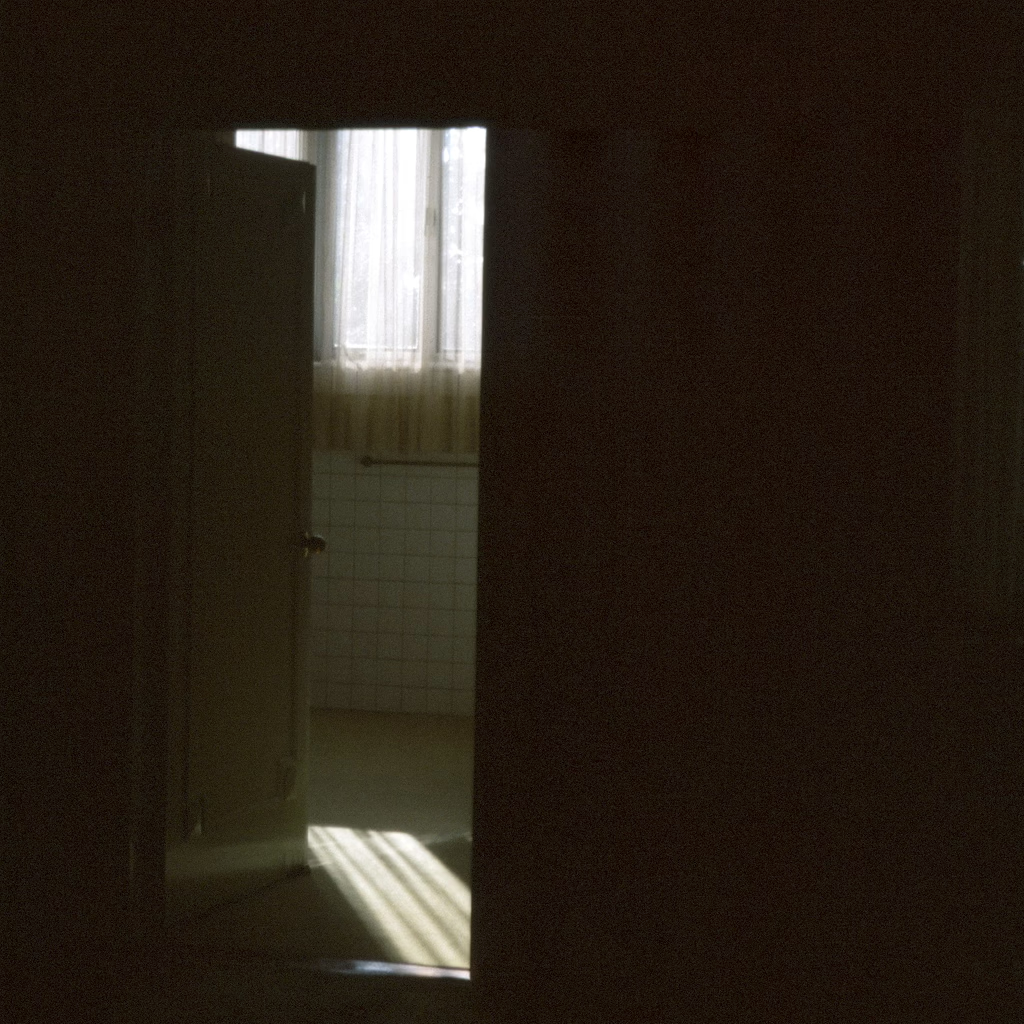
Basement Apartment
They lay in the dark on opposite sides of a bed the size of a small country, two continents that had agreed, long ago, never again to touch.
There had been a time — she could almost locate it, the way you can almost locate a dream on waking — when his hand on her shoulder had meant something other than a closing argument. That time was gone the way the light goes out of a fish on ice. What remained was the arrangement. He had promised her the highest office in the land, and out of some last gray ember of whatever a soul is, he intended to keep that promise. The money was already moving. A billion dollars, give or take, routed through enough shells to make a marine biologist weep, all of it bent toward a single purpose: putting her behind a podium with a seal on the front.
She had spent the afternoon being photographed in a stranger's home.
It had been arranged, of course. Everything was arranged. The working woman, the warm kitchen, the borrowed children — two sullen teenagers from a marriage that had ended, and a two-year-old they had placed in her arms because the consultants said a child in the arms tested eleven points warmer than a child at the knee. She had held the toddler and smiled the smile they had measured, and through all of it her mind had been elsewhere, a blur, a hum, until the moment she looked through the blinds.
"The windows were half-size," she said now, into the dark, to no one, to him. "They'd dug into the ground outside and poured concrete and painted the slab some sick color so the light would bounce in. The light came in sideways. When I looked through the blinds I saw the concrete angled up toward the sky like the wall of a grave that hadn't been finished."
He said nothing. He was reviewing tomorrow behind his eyes.
"I almost vomited," she said. "At how cramped I felt. No animal would live that way. No animal would choose it." She turned the word over. "She was pregnant. A fourth one. And she was — " here her voice did something strange, snagged on a thing she could not name — "she was satisfied. That's what I couldn't stand. She wasn't being crushed. Nobody was standing on her. She lived half-buried in the dirt and she was content, and it made me sick in a way I can't — "
And there it was, the shred of her, misfiring like a nerve in a severed limb. She had felt something in that basement apartment. But the something had pointed the wrong way. She was not disgusted by the grave they made people live in. She was disgusted that the woman had not had the decency to despair in it.
"They'll fix the speech," the husband said finally, because he had heard nothing she said and everything he needed to. "Tell me about tomorrow."
So she told him about tomorrow, and as she spoke the warmth left her voice entirely, and what came out instead was the language of the men who wrote her words — men with soft hands and clean nails and the eyes of accountants, who could sit in a glass conference room and take a human being apart into demographics the way a butcher takes apart a hog, with no more malice and no less.
"They've got the Joe Six-pack piece dialed in," she said. "There's a type they test against — the man in the diner, the man with the truck, the six-pack and the cap. They don't even use his name in the room. He's a segment. He's a number that moves if you frighten it correctly." She recited it the way you recite a grocery list. "You give that number someone to look down at. You give him a word for the people beneath him so he never looks up at the people above him. That's what the consultants are for. They launder the cruelty into policy. They take the ugliest thing a frightened man can think about his neighbor, and they hand it back to him as common sense, as security, as me, fighting for you. And he votes. And he never notices that the boot he's cheering for is standing on his own throat too."
She was quiet a moment.
"We get them under the heel," she said. "All of them. The frightened ones first, because they're cheapest."
The husband nodded in the dark, satisfied as a man can be who has forgotten what satisfaction was for. Tomorrow she would stand in the light and say the measured, poisonous, focus-grouped words, and a nation of butchered numbers would roar.
That was the plan.
But there is always a hand the planners do not account for.
The phrases your clever men found in the polling and mistook for gold — the dog-whistle that tested so warm, the contempt dressed as kinship, the lovely poisoned line about people who are not in the room — I salted that ground myself, the way a farmer salts a field he means to leave fallow forever. I walked the corridors of your consultancy at three in the morning when even the ambition sleeps, and I leaned over the shoulder of the man with the soft hands, and I whispered the perfect, ruinous word into the perfect, ruinous sentence, and I watched him write it down and smile.
Because it will destroy you. Because somewhere in that frightened nation there are still enough hearts not yet wholly butchered to hear the cruelty under the music, and recoil, and pull the lever the other way. Your campaign is going to die of its own cruel perfection, and I am the one who lit the fuse.
Understand what I am confessing, you two cold gnarled things in your enormous cold bed. I am the adversary. I am the one your scriptures blame for every rot and ruin since the garden. Lying is my mother tongue. Despair is the house I keep. I have ushered empires into the fire and hummed while they burned.
And I looked at your plan — to take the lowest, most frightened man in the land and teach him to spit on his own brother so that he will never, ever look up — to grind a whole people half into the earth and then resent them for not weeping about it — to do all of this not in the heat of some grand wicked passion but coldly, on a spreadsheet, for money you will not live to spend —
— and I could not.
Do you hear the size of that? I could not. There is a floor even in Hell. There is a depth past which the architecture of damnation will not bear weight, and you have been pouring concrete beneath it, you and your soft-handed men, building basements under the basements, and calling the absence of light "the will of the people."
*I corrupt. I do not erase. I tempt the soul because the soul is real and worth the taking. But you — you do not tempt the man in the diner. You unmake him. You hollow Joe into a number and fill the number with hate and aim it at his neighbor, and you call it winning.
There is nothing left in him for me to bargain with. You got there first. You took my work and you industrialized it, and you stripped out the one ingredient I always required — the choice.*
So I have appointed myself, this once, the most absurd office in creation. I, the father of lies, am going to protect the truth. I, who hate you each and all, am going to be — God help us both — the better angel in this room, because the better angels appear to have gone home, sickened, and someone has to mind the door.
Sleep, you frozen abomination. Sleep on your continent of a bed and dream your spreadsheet dreams. Tomorrow you will speak my words in the warm and measured voice your men prepared, and you will feel the crowd rise, and you will mistake the roar for your beginning. But the word Superpredator is the match I light
I lit it for the man in the diner. I lit it for the woman with the half-windows, content in her finished grave, carrying a fourth small light into a world that would price her by the head. I lit it for the children you borrowed and measured and handed back.
And I lit it because of this, which is the only true thing I will ever say to you:
When the devil himself reads your plan and pushes it back across the table — when even I look at what you have built and say no, not this, not this far — you are not standing at the edge of greatness.
You are standing somewhere I would not follow.
Be careful, my cold and clever children.
Be very careful what you wish for.