What Does A Happy Little Programming Milestone Look Like?
I am a firm believer that programming is the only thing, that can set a person free from poverty.
In the age of AI, that is even a firmer statement.
And I remind you software does not need a warehouse, and AI means you already have a team of programmers.
Furthermore, know that 2026 is the age of Virtual Reality, the leading software is still in beta.
But even local AI, is now capable of converting images, to 3D models that you add to your virtual worlds.
When I started programming I didn’t know milestones existed, so today I wanted to show you what one looks like.
That you don’t need to finish you program, to create great things.
In the age of AI, it is hard not to finish your programs, as AI loves nothing more than good ideas it can run with.
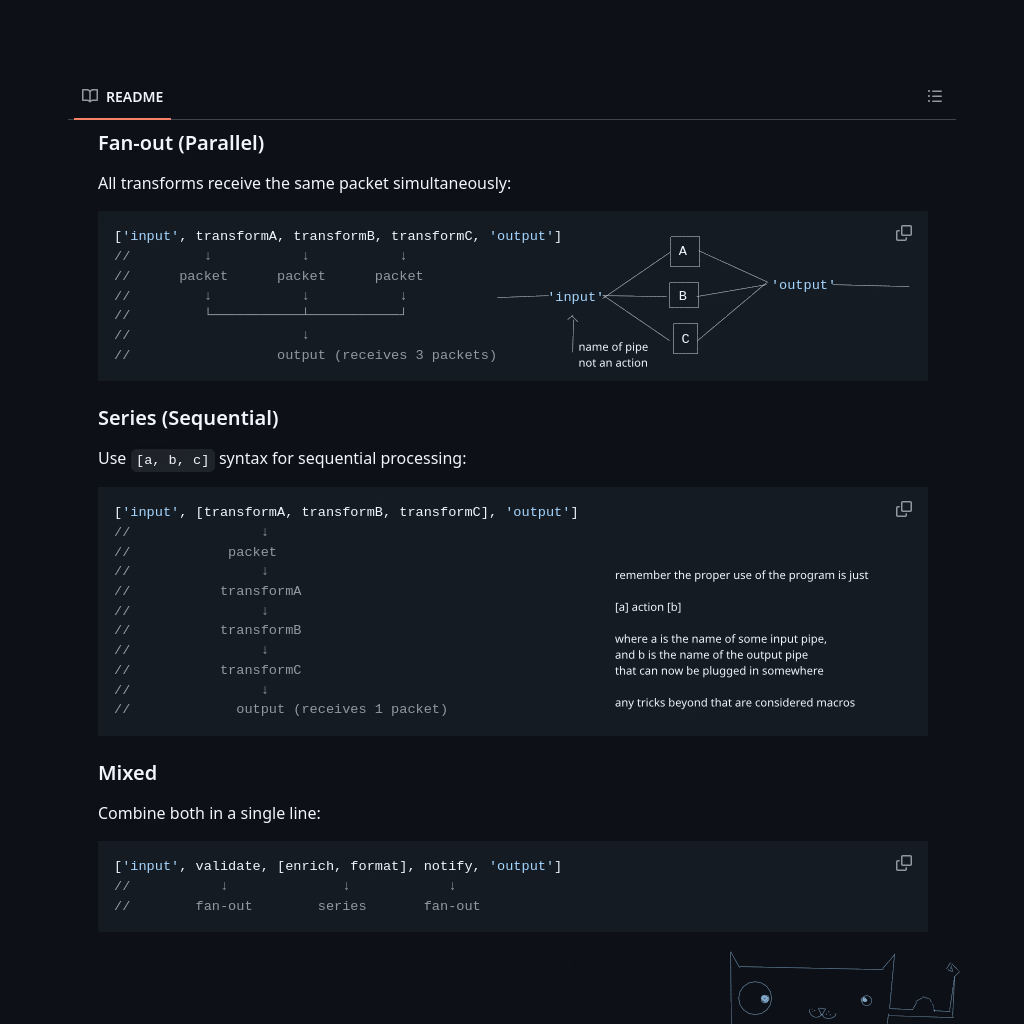
So I attach a working flow based programming system, managed by a textual visual programming language I named lulz.
I canceled my big AI, but I don’t know how long that will go on for, the $20 per month Ai is so useful that it becomes part of being on the internet.
I canceled it, as a triumph, I had my fill of AI research, to say the least, and I finally internalized that the AI you can run at home, but fit in your VRAM.
Your video card memory is the hard limit of what you should run at home, when your AI does not fit, you fo from break neck 70 tokens a second, to fast 7.
Seven tokens per second is faster than you can read, but that’s for experiments, for when you have time for fancy work.
For serous work, you want your AI in RAM.
With 18 days left, on the big AI, Claude is writing my visual programming language upstairs.
It is not visual in the sense that I use the mouse, the mouse was too slow, it is visual in the sense that there are boxes and there are cables.
It is based on ffmpeg filtergraph concept, but in JavaScript array notation, originally a 20 line program.
Now whatever behemoth Claude is creating is full of tests, and borrows Action ideas from Node-RED.
Node-RED is about general purpose programming, ffmpeg filtergraph is for video processing, Node-RED is wiser for now.
I still want to create a Visual Visual Programming Language, many of them, by giving AI good instructions.
BUT, those instructions are too long for the $20 AI, it is either local AI that can program non stop.
Or $100 AI that has less usage limits, I’ll find out his year, probably local AI, with instructions by $20 AI.
There is problem with visual visual programming, because you need, to group nodes to create reusable actions, and nest them, and mangle them.
That is hard on the mind, there is a lot of GUI programming, and this is in deed the grunt work that AIs excel at.
A human can create a simple visual programming language in a year, an AI can create a deluxe programming paradise that changes the world in a day.
This is great research, well balanced results, I am closing my visual visual programming chapter with AI.
But there is something about visual programming in text, ffmpeg filtergraph programmers discovered out minds can keep track of cables.
Cables, just connect, you never ask what does the cable do.
The cable does the same thing it always does, connects action outputs to other action inputs.
And in text, if you want to know where cable labeled A comes from, you look for letter A, the code editor will highlight that for you.
Originally I was working on visual programming to help the world program, now that AI has proven it self, it need to be able to program the flows.
You do not want the AI using the mouse, so text visual programming is perfect here.
The code that Claude is creating upstairs, posed no trouble, Claude instantly identified and understood what I was doing.
It can read the JavaScript based filtergraph notation, it seems to be able to connect the cables in its mind as well as we do.
In closing this must be kept short, this gibberish you have just witnessed here marks a revolution in AI coding.
We can’t really ask AI to read out mountains of code, the human slop is atrocious.
But we can ask AI to use flow based programming, or visual programming, which gives it chains and chains of little programs it can and reason about.
If there is ever any trouble, and tre won’t be, an AI can listen to a cable, to inspect the data, objects, passing through it, it will sample the tiny little things there, and understand everything.
I can see how smartphone AI could create little programs, there is something very auto-complete about flow based programming.